
How an IP-PBX works
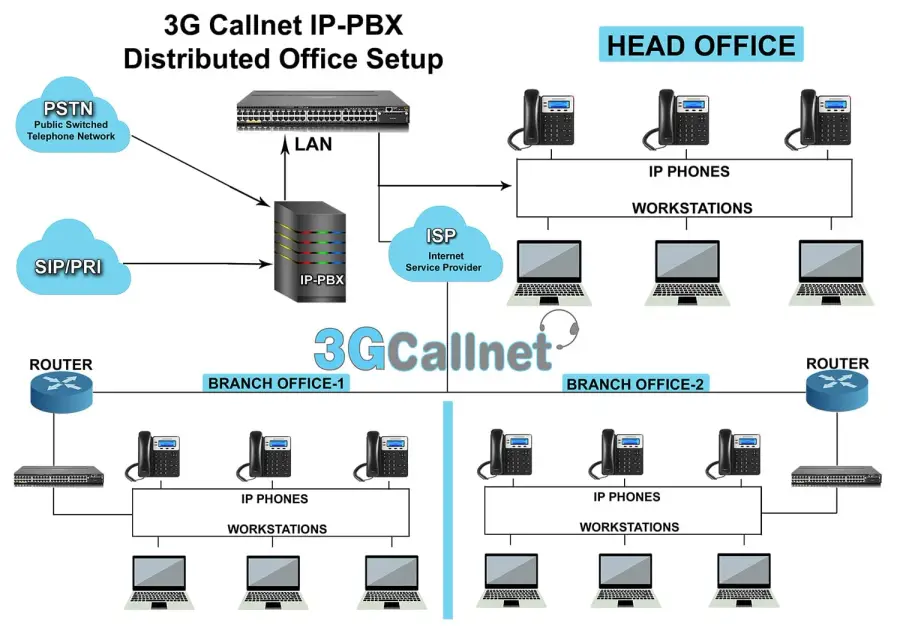
- Extensions – IP phones, softphones and (through FXS gateways) analog phones connect over the office network.
- Outside lines – SIP trunks, PRI lines (via PRI card or gateway), GSM SIMs or analog lines (via FXO gateway).
- Call handling – the IP-PBX routes calls between extensions and outside lines and provides features such as IVR, queues and voicemail.
- Internal calls between extensions and between branch offices do not use outside lines.
3G Callnet IP-PBX vs EPABX
| Features | IP-PBX | EPABX |
|---|---|---|
| Per Extension Cost | No | Yes |
| Caller ID | Yes | Yes |
| Call Transfer | Yes | Yes |
| Call Parking | Yes | Yes |
| Call Forwarding | Yes | No |
| Call Recording | Yes | No |
| Call Reporting | Yes | No |
| Voicemail | Yes | No |
| Voicemail to email | Yes | No |
| Auto-Attendant/IVR | Yes | No |
| Do Not Disturb | Yes | Yes |
| Call Queues | Yes | Yes |
| Music On Hold | Yes | Yes |
| Office Hours | Yes | No |
| Instant Call Control | Yes | No |
| Conference Rooms | Yes | No |
| Phone Directory | Yes | No |
| Intercom | Yes | Yes |
| Application/Browser | Yes | No |
| Remote Users | Yes | No |
| Multiple Offices | Yes | No |
More detail in our guide: IP-PBX vs EPABX.
Benefits of an IP-PBX
- Easier installation and configuration than proprietary phone systems.
- Make and receive calls anywhere – remote users and mobile softphones.
- Lower operating costs over time – free internal calls between users and branches, and lower-cost VoIP routing.
- One network for voice and data.
- No provider lock-in – based on the open SIP standard, so you can choose phones and trunk providers.
- Built-in IVR, queues and call recording – see IVR and call center dialer.
What to buy with an IP-PBX
IP phones, headsets, and a gateway or card for each type of outside line you use. Not sure which? Use the Product Finder.
Frequently asked questions
What is an IP-PBX?
An IP-PBX (Internet Protocol Private Branch Exchange) is a phone system that switches calls over an IP data network. It connects IP phones and softphones inside the office and routes outside calls through SIP trunks, PRI lines, GSM or analog lines.
What is the difference between an IP-PBX and an EPABX?
A traditional EPABX switches calls in dedicated hardware with a fixed number of line and extension cards. An IP-PBX is software on the data network, so adding users is easier and features like voicemail-to-email, call recording, IVR, remote users and multiple offices are built in.
Can I keep my existing phone lines?
Yes. PRI lines connect through a PRI card or PRI gateway, analog lines through an FXO gateway, mobile SIMs through a GSM gateway, and existing analog phones through an FXS gateway.
Can staff work from home on an IP-PBX?
Yes. Remote users can register a softphone or IP phone over the internet and use their office extension from anywhere.
Which phones work with the IP-PBX?
Standard SIP phones such as Grandstream, Sangoma and OpenVox IP phones, softphones on PCs and smartphones, and analog phones through an FXS gateway.
Last updated: 4 November 2026